
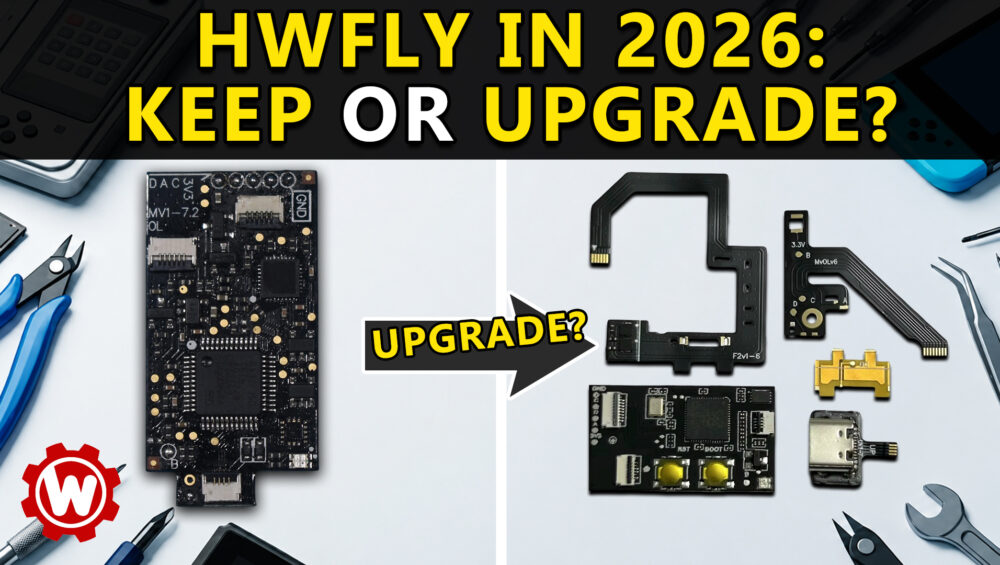
HWFLY Modchip in 2026: Install, Repair or Upgrade
HWFLY is a previous-generation Nintendo Switch modchip — a hardware chip that lets patched V1/V2, Lite, and OLED consoles boot custom firmware. If you own one, Wayayeo can install it, repair a botched install, or swap it for a modern chip through our professional Switch modchip installation service. For brand-new installs, we'll tell you straight: a current-generation chip like Picofly or INSTINCT-NX is the better buy. Here's the full picture.
What Is an HWFLY Modchip?
HWFLY is a family of internal modchips for the Nintendo Switch that appeared after the original SX Core and SX Lite chips left the market. Like those chips, an HWFLY is micro-soldered to the console's board and works by briefly glitching the CPU voltage at boot, which lets the console load a custom bootloader instead of the stock one. From there, the console can run custom firmware and homebrew software.
The reason chips like HWFLY exist at all: only early, unpatched V1 consoles can run custom firmware through a software exploit alone. Every patched V1, V2 ("Mariko"), Switch Lite, and Switch OLED needs a hardware modchip — and that's the market HWFLY served.
HWFLY Versions: V1, V2, V3, V4 and Beyond
HWFLY chips shipped in several revisions, usually labeled V1 through V5 and up — but the version number isn't a simple "higher is better" ladder. For the most part it tells you the board's form factor and which console it was designed to fit (for example, V3-era boards for Mariko/V2 consoles, V4 for OLED). The reliability differences come down less to the number and more to who built the board and what FPGA it uses: the well-regarded HWFLY V4 uses a flashable QFN FPGA, while some later V5-labeled boards came from a different group using a BGA FPGA with known quality-control and stability issues. This is also why the modern INSTINCT-NX exists — it's widely understood to be the successor to the original HWFLY V4 line rather than a different chip entirely.
Here's the practical truth from the bench: if your HWFLY — whatever the version — trained successfully and boots custom firmware today, the version number doesn't matter much. What matters is the quality of the installation. A clean install on an early chip outlasts a sloppy install on a late one.
On firmware: HWFLY chips ship with their firmware already on the chip — a variant of the open-source Spacecraft-NX lineage — and if your console boots and trains correctly, you generally never need to touch it. Many HWFLY chips can be updated to the community hwfly-nx firmware, but not all: flashable chips use a QFN FPGA, while chips built around a BGA FPGA can't be reflashed at all. If a chip won't boot, that's rarely a firmware download away from fixed — figuring out whether you're dealing with a training issue, a bad solder joint, a marginal glitch, or an unflashable board is exactly the kind of diagnosis that belongs on a bench.
HWFLY vs Picofly vs INSTINCT-NX
Three chips come up in almost every conversation about modding a patched Switch. Here's how they actually compare:
| HWFLY | Picofly | INSTINCT-NX | |
|---|---|---|---|
| Generation | Previous generation (post–SX Core era) | Current generation | Current generation |
| Design | Closed commercial design | Open-source, built on the Raspberry Pi RP2040 | Commercial, factory-assembled |
| Availability | No longer in active production — secondhand and old stock only | Widely available — we stock the RP2040 Picofly modchip at $21.99 | Available as a $19.99 upgrade option on our install service |
| Console support | Patched V1, V2 (Mariko), Lite, OLED (varies by chip revision) | V1 (Erista), V2 (Mariko), Lite, OLED | OLED |
| Our take | Fine if you already own one that works; not worth hunting down for a new install | The budget pick — huge community, actively maintained | What most of our customers choose — consistent factory QC |
One honest aside: if you have an original unpatched V1 (Erista) Switch, it can run custom firmware without any chip at all — a modchip on those consoles is a convenience, not a requirement.
Is HWFLY Still Worth It in 2026?
If you already own an HWFLY-modded console that boots reliably: yes, leave it alone. There is no upgrade treadmill here — a healthy HWFLY does the same job as a modern chip, and ripping out a working install to replace it with something newer is money spent on nothing.
If your HWFLY chip or install has failed, it's usually worth repairing rather than replacing the console. And if you're starting from scratch with an unmodded Switch, don't go looking for an HWFLY — new stock is scarce, and the modern chips are cheaper, better supported, and what we install every day. That's not a sales pitch; it's the same thing we'd tell a friend.
Getting an HWFLY Installed — or a Failed Install Fixed
Wayayeo has been doing board-level Switch work in the Dallas, TX area since 2010, with 1,037+ five-star Google reviews. Modchip installation is micro-soldering on a dense board — the most common consoles we see are ones where a DIY install or a bargain shop went wrong. We take the jobs other shops turn away.
Every mail-in install through our Switch modchip install service includes board-level micro-soldering, an internal clean, fresh thermal paste, and a full boot test before it ships back. Turnaround is 24–48 hours once your console hits the bench, the work carries a 180-day warranty, return shipping is free, and you pay after the work is done. Our standard Switch installs include the chip — so if you already own an HWFLY and want us to install your chip instead, contact us first so we can set that up before you ship.
If a previous HWFLY install failed — console won't boot, no backlight, black screen after a "successful" mod — our failed modchip repair service covers recovery and proper reinstallation, typically $119.98–$139.98 depending on board damage. You supply the chip from the original install; we handle lifted pads, damaged traces, and the cleanup.
OLED owners: HWFLY was the go-to chip for OLED installs in its day, and the OLED is still the model where install technique matters most. That work runs through our Switch OLED modchip service; Lite consoles have their own dedicated Switch Lite modchip service. If you want the technical background first, we've written up the DAT0 vs Kamikaze breakdown of the two OLED install techniques, plus a step-by-step look at how the OLED Kamikaze install works.
Ready to mod your Switch — or rescue a failed install?
Mail it in. We install your HWFLY or a modern chip, clean the console, repaste it, and boot-test it before it ships home. Hardware only — your accounts, saves, and SD card are never touched.
Book your modchip install →From $89.98 · 24–48hr turnaround · 180-day warranty · free return shipping · Dallas, TX since 2010
HWFLY Modchip FAQ
Is the HWFLY modchip still good in 2026?
Yes — if you already own one and it was installed correctly, a working HWFLY still boots custom firmware just fine, and there's no reason to remove a healthy chip. For brand-new installs, we recommend a current-generation chip like Picofly or INSTINCT-NX instead, since HWFLY has been superseded and new stock is hard to find.
What is the difference between HWFLY and Picofly?
HWFLY is an earlier commercial modchip family; Picofly is a newer open-source design built on the Raspberry Pi RP2040 chip. Both do the same job — enabling a patched Switch to boot custom firmware — but Picofly is cheaper, easier to source, and actively maintained by the community, which is why it's the standard choice for new installs today.
Can you install an HWFLY chip I already own?
Yes — but contact us first. Our standard Switch installs include the chip, so if you want us to install your own HWFLY instead, reach out before you ship so we can set that up for you. Once it's arranged, the install runs through our normal mail-in service: micro-soldering, internal cleaning, fresh thermal paste, and a full boot test before return shipping.
Which Switch models does HWFLY work with?
HWFLY chips were made for the patched original Switch (V1), the V2 "Mariko" Switch, the Switch Lite, and the Switch OLED — the consoles that can't run custom firmware through a software-only exploit. Different HWFLY hardware revisions target different console models, which is one reason installation experience matters.
My HWFLY install failed and the console won't boot. Can it be fixed?
Usually, yes. Failed modchip installs are one of our specialties — lifted pads, damaged traces, and consoles other shops have turned away. Our failed modchip repair service typically runs $119.98–$139.98; you supply the chip from the original install, and the completed work is covered by our 180-day warranty.
Where can I buy an HWFLY modchip?
New HWFLY stock is scarce — most listings today are old inventory or secondhand chips of unknown condition. Honestly, rather than hunting one down, buy a current chip: we sell the RP2040 Picofly for $21.99, and INSTINCT-NX is available as an option on our installation service.
Do I lose my saves or account when you install or repair a modchip?
No. Our work is hardware-only — we never touch your accounts, saves, or SD card. Your console comes back with everything exactly as you sent it, plus a cleaned interior and fresh thermal paste.
One bench, every chip: HWFLY, Picofly, INSTINCT-NX
Whether it's a fresh install with a modern chip or an HWFLY that never booted right, the fix starts the same way: mail it to the bench that's been doing this since 2010. Get started with a professional mail-in modchip install, or send a botched job to our repair bench for failed installs.
Mail in your Switch →From $89.98 · 24–48hr turnaround · 180-day warranty · free return shipping · Dallas, TX since 2010


